
3D Magnetic Inversion Reveals Significant Interconnected Body Beneath Mineralized Zones
Vancouver, British Columbia – February 26, 2025. Cascade Copper Corp. (CSE: “CASC”) (“Cascade” or the “Corporation”) is pleased to announce that it has completed a 3D magnetic inversion of the recently flown airborne magnetic-radiometric survey on its Bendor Gold-Tungsten Project (the “Project”), located ~15 kilometres northeast of the operating high grade underground Bralorne Gold Mine near Gold Bridge, British Columbia, Canada.
Summary:
- 3D Magnetic Inversion delineates a large interconnected intrusive body with numerous cupolas stretching toward surface located beneath the known gold-bearing mineralized zones and gold-in-soil anomalies
- Cupolas likely represent multiple “blind” intrusions of the Bendor Intrusive Suite mapped on the Project and known in the area as being closely linked in timing and space to gold-bearing systems
- Project located proximal to Talisker Resources’ operating Bralorne Mine and Endurance Gold’s Reliance Project
- Historical samples from underground workings at Bristol assayed up to 30.86 g/t Au and 6.5 % WO3
- Widespread untested gold-in-soil anomalies across the Project
Next Steps:
- Integration of the magnetic inversion into a cohesive 3D geological model of the mineralizing environment including historic mine workings and underground drilling to aid future exploration and drill targeting
- Plans to submit a diamond drilling and geophysics permit applications in the near-future following completion of the Project-wide 3D compilation and geological data modelling
- Expanded Project-wide soil sampling with modern multi-element analysis for pathfinder target generation
- Detailed mapping and sampling of known mineralized zones and gold-in-soil anomalies
- These efforts will potentially lead to diamond drilling targets in 2026
After completion of the 3D magnetic inversion, the Corporation believes that the gold and tungsten mineralization reported from the historic Bristol Mine workings and adjacent mineralized vein systems could be linked to the magnetic cupolas and their related hydrothermal systems and may continue along strike and to depth. Historical samples from underground workings at Bristol are reported to have assayed up to 30.86 g/t gold and 6.5 % tungsten trioxide (WO3) and a 23kg sample taken from a winze reportedly assayed 48 g/t Au, 20.6 g/t Ag, and 0.16 % WO3.
Shannon Baird, VP Exploration for Cascade Copper remarks “The previous exploration work at Bendor has shown some impressive values of gold, tungsten, and silver throughout the Bristol and Benboe workings and vein systems. We are extremely excited that the 3D magnetic inversion modelling has verified the potential interconnected nature of all these showings and we are excited to get on the ground and follow up on these newly generated targets. By all indications, there exists significant potential to expand on the mineralized gold system at Bendor.”
The Bendor Project has only had minimal surface exploration work in the past and has only been shallowly drilled within a narrow region surrounding the historic mine workings at Bristol. For a detailed breakdown, the previous news release dated November 20, 2025 details the historical results at Bendor.
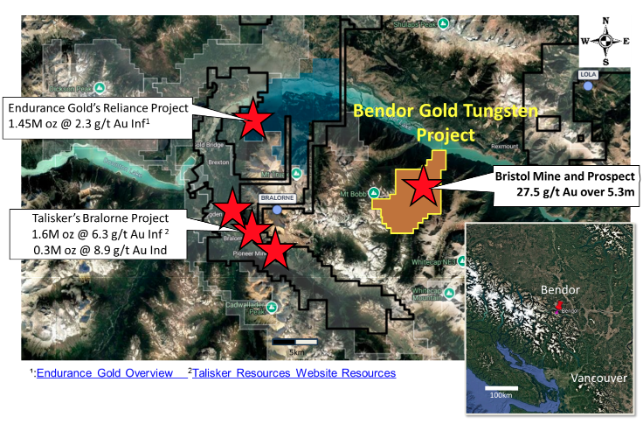
Figure 1: Bendor Project Location in Relation to Bralorne Mine, Reliance Project and Major Centres
Airborne Magnetic Surveys
Cascade Copper commissioned an airborne magnetics-radiometrics survey that shows a strong correlation with geology and mineralization with high magnetic intensity in the south and central portion of the Project where the various Bendor intrusives likely created a hornfelsing of the local lithologies. There also exists a strong correlation of lower or disrupted magnetic intensity to structural complexity and offsets where hydrothermal fluids tend to focus. The highly magnetic central portion of the project is interpreted to be a zone of hornfelsing and hydrothermal alteration with potential magnetite, gold, tungsten, silver, and copper enrichment. The majority of the historic gold-in-soils and surface sampling with high gold values have been associated with this highly underexplored magnetic halo zone.
In partially glaciated terrains like Bendor with thin till scree coverage and very minimal outcrop exposures on the valley slopes and walls, geophysics such as EM and magnetics play a crucial role in discovery. Inversion of the magnetics data allows us to model and project subsurface magnetism and see large scale and localized zones of magnetic anomalism that could be caused by hydrothermal alteration and potentially mineralizing fluids. The Bendor Project has several “clustered” target zones of intense magnetics probably outlining the presence of cupolas stemming from an underlying Bendor intrusive. When the surrounding country rock is infiltrated by intrusions carrying hot mineralizing fluids it creates a very distinctive magnetic signal and/or halo that can help zero in on the most prospective target zones to follow up on. This inversion exercise has done just that. Besides clearly identifying the known outcropping Bendor intrusive and related hydrothermal alteration and mineralization, it has outlined several other large analogous zones of high interest clustered within an ~10km2 zone on either side of the Tommy Creek Fault and historical Bristol Mine workings.
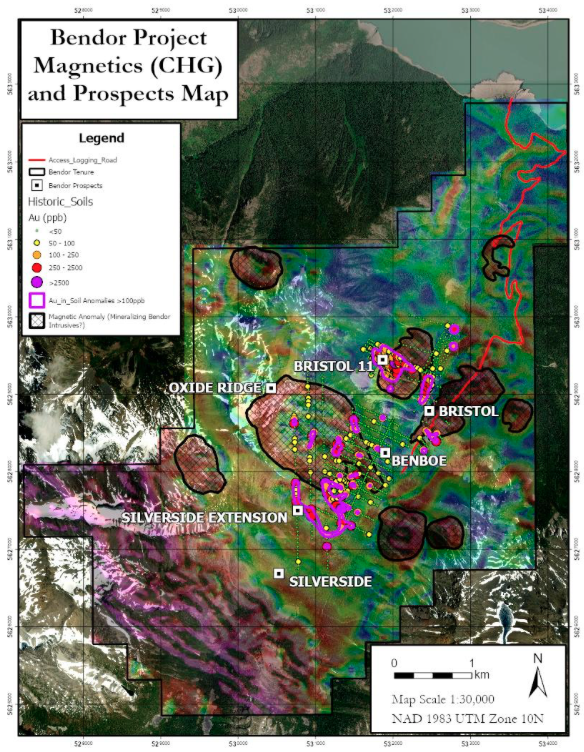
Figure 2: Bendor Project with prospect locations, soil results, and areas of High Magnetic Intensity. Magnetic anomalies are associated with “at or near surface” intrusives related to the Central Bendor Pluton and Gold Mineralization
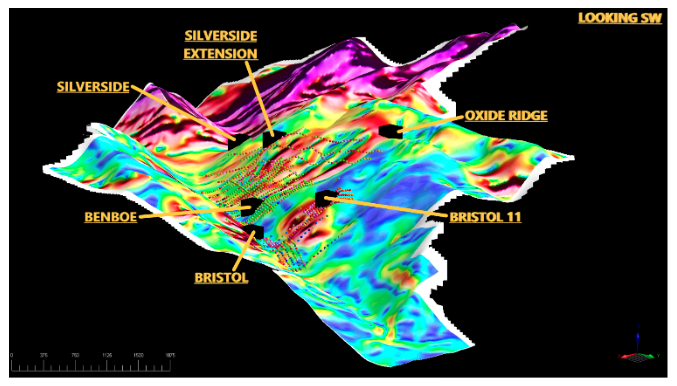
Figure 3: Bendor CHG Magnetics Draped on Topography with Historic Au-in-Soils and Prospects
Magnetic Inversion Results and Implications
More detailed surficial 2D gridding and a subsurface 3D magnetic inversion model has been completed on the airborne magnetic-radiometric data flown over the entirety of the Project. This was done to test the theory that the clustered circular magnetic features observed in the surficial data are actually connected to a larger subsurface body of the Bendor Intrusive Suite known to be associated with gold mineralization in the region. The Corporation felt this was a necessary exercise to perform since magnetics appears to correlate well with known geology and mineralization, and we feel this will significantly assist in subsurface structural and the on-going geological modelling and delineate potential zones of alteration and mineralization to target in future drilling campaigns.
Magnetic Bodies Interpreted as Bendor Intrusive
Initial review of the inversion model has verified the theory of a potential mineralizing intrusive interconnected at depth and related to the known surficial gold mineralization. Interestingly, there is only one larger known outcropping of the Bendor pluton which correlated exactly with the larger circular magnetics feature in the centre of the Project. The other magnetic cupola target zones are buried under thin cover and don’t outcrop at surface but their magnetic influence is definitely seen in the surface data.
Of note as well is that the large central 2-D magnetics feature is actually a mag-low surrounded by a ring of high magnetics which the Corporation interprets to be a hornfelsing and alteration of country rock by the intrusive and its hydrothermal fluids. However, when looking at the other magnetic anomalies are near solid magnetic high features. This could be explained by depths of the intrusion emplacement and erosional levels.
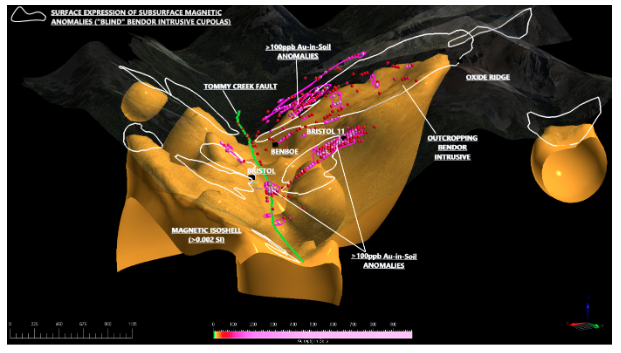
Figure 4: Looking SSW up Tommy Creek with the Magnetic Inversion interpreted Bendor Intrusive, the white outlines as the intersection of the intrusive at surface and the anomalous soil samples as coloured dots
Structural and Alteration Corridors
The Tommy Creek Fault and Shear Zone which hosts the Bristol Mine workings and the Benboe vein emerges from the inversion modelling as an area of magnetic erosion. In other words, the magnetic response in this area has been diminished. It is interpreted that the structures along the trend have carried fluid that have destroyed the magnetic component of the Bendor Intrusive. It is possible that the Tommy Creek Fault and Shear has succumbed to multiple episodes of deformation and fluid flow which has resulted in the gold and tungsten bearing veins found at the Bristol Mine. (See Figures 4 and 5)
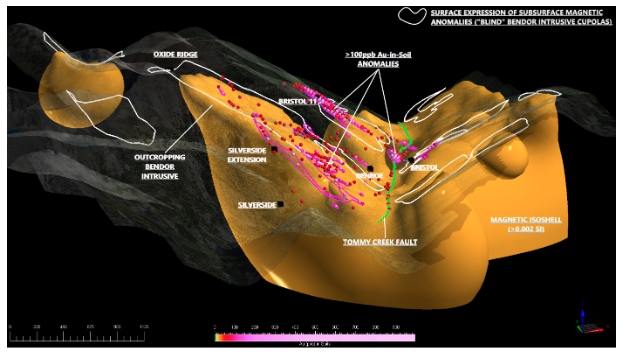
Figure 5: The Tommy Creek Fault and Shear hosts the Bristol Mine and the Benboe Vein (looking NNE) Note the magnetic erosion of the Bendor Intrusive along this trend.
The very distinctive weathered slope located south of the Bristol 11 Prospect hints at strong sericite clay alteration. (see Figure 6) The alteration zone is adjacent to the large gold in soil anomaly at the Bristol 11 prospect and is within a magnetic low area between two magnetic intrusive bodies. It is noted that soil sampling has not covered this distinctive alteration zone and will be a top priority in the next field program. The alteration zone fits with the theory of a hornfelsing and mineralization event associated with the contacts of the intrusives. It is also noted that there may be a structure associated with the alteration trend that mimics the directions of the neighbouring Bralorne- Pioneer mine and Reliance inferred resource.
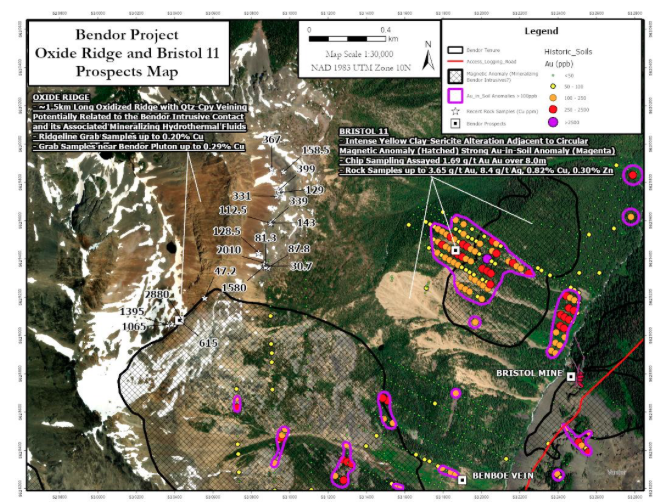
Figure 6: Orthophoto showing The Oxide Ridge Prospect with copper grab sample results and the Bristol 11 Prospect with gold-in-soil anomalies. Note the area of Intense Clay-Sericite Alteration has not been completely sampled.
Oxide Ridge
The Oxide Ridge Prospect is a newly discovered area with only a few traverses across the eastern flank of the ridge done by Cascade’s team during acquisition due diligence. The presence of sulphide veining and copper oxide staining as well as highly anomalous grab samples indicates an intriguing area for future follow up work. (See Figure 6)
Near-Term Targets
Completion of the 3D magnetic inversion along with an overview compilation and review of all historical mining, sampling, and drilling data in combination with the recent airborne magnetics and LiDAR survey data have revealed several targets worthy of “near-term” follow-up in the field. Subsurface geological modelling is expected to generate additional high-priority targets in preparation for drill permitting and diamond drilling.
Next Steps
The recently completed detailed magnetic inversion modelling exercise indicates a strong correlation of anomalous to high grade gold, silver, tungsten, and copper to high magnetics with mineralizing intrusive contacts and low magnetic disruptions associated with structural features focusing hydrothermal fluids that carry the gold. Taking this into account, the Corporation believes that performing additional detailed and refined 3D geological modelling of all historical maps and data along with mining and assay data will significantly help further delineate priority drill targets. The Corporation also plans to submit a diamond drilling and geophysics permit application shortly following completion of the Project-wide compilation of historic data and geological 3D modelling. Additionally, newly verified surface magnetic and gold-in-soil anomalies will be ground-truthed early in the next field season.
The technical information in this news release was prepared and reviewed by Shannon Baird, P.Geo., a Qualified Person as defined in National Instrument 43-101. Mr. Baird is Vice President of Exploration of Cascade Copper Corp. and registered as a Professional Geoscientist with the Professional Geoscientists of Ontario as well as the Engineers and Geoscientists of British Columbia.
Management cautions that historical results are unverified and that grab samples are selective in nature, and the assay results may not necessarily represent true underlying mineralization.
References for Historical Data
*Please note that all assay values contained within this release are from previous operators, considered to be “historical” in nature, and have not been independently verified by Cascade Copper. The values have been extracted from publicly available government resources including Assessment Reports and MinFile inventory details and it is unknown what type of quality-control programs were performed at the time.
About Cascade Copper
Cascade Copper is an exploration stage natural resource company engaged in the evaluation, acquisition, and exploration of copper based mineral resource properties. Cascade is focused on copper and gold, porphyry and mesothermal gold deposits in British Columbia and VMS and BIF copper, gold and silver style deposits in Ontario. Cascade’s priority is to conduct exploration using modern technology that includes 3D inversion modelling of geophysics, LiDAR derived elevation models and AI enhanced predictive modelling from all historic and modern data inputs. Drilling is planned on several of its copper projects this year. Cascade has five projects, including the Copper Plateau Copper-Moly Project, the Centrefire Copper Project, the Rogers Creek Copper-Gold Project, Fire Mountain Copper-Gold Project and the Bendor Gold Project where it is earning a 100% ownership over 4 years through staged exploration expenditures totalling $275,000 and issuing shares and stock to the vendor.
FOR FURTHER INFORMATION, PLEASE CONTACT:
CASCADE COPPER CORP.
Jeffrey S. Ackert, President and CEO
820-1130 West Pender St.
Vancouver, BC V6E 4A4
Telephone: 1 613 851 7699
E-Mail: [email protected]
Neither the CSE nor its Regulation Services Provider (as that term is defined in the policies of the CSE) accepts responsibility for the adequacy or accuracy of this release.
DISCLAIMER & FORWARD-LOOKING STATEMENTS
This news release includes certain “forward-looking statements” which are not comprised of historical facts. Forward-looking statements are based on assumptions and address future events and conditions, and by their very nature involve inherent risks and uncertainties. Although these statements are based on currently available information, Cascade Copper Corp. provides no assurance that actual results will meet management’s expectations. Factors which cause results to differ materially are set out in the Corporation’s documents filed on SEDAR. Undue reliance should not be placed on “forward looking statements.”